 Greek
 English
 Czech
 Danish
 Finnish
 French
 German
 Italian
 Norwegian
 Romanian
 Spanish
10 Things Your Friends May Not Know About Drugs (Part 4)
Myth: “Most drugs are not habit-forming.” True or false? False. The reality is straightforward: when a drug wears off, a person naturally wants more. Understanding the biological reason behind that craving removes mystery and shame—and shows exactly how casual use quietly turns into dependence.
What Burns Up Inside the Body During a High
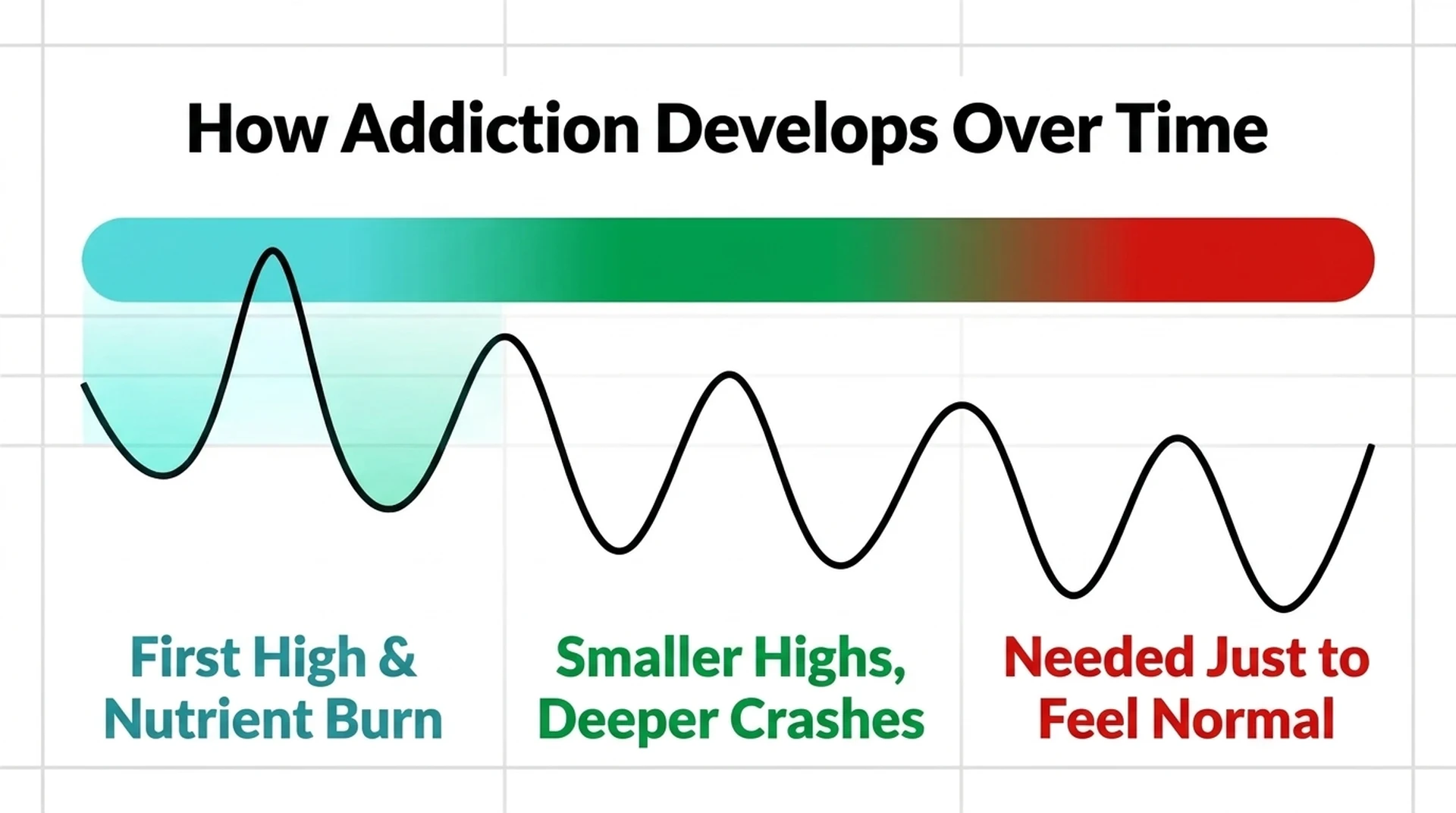
Picture a horizontal baseline representing someone under mild everyday stress. When they take a drug, it temporarily lifts them above that stress.
However, forcing the body into an artificial state carries a metabolic price. Inside the body, essential nutrients are rapidly burned up and depleted to process the substance:
- Calcium: Crucial for calm nerve transmission and physical relaxation.
- Vitamin C: Used heavily by the body in stress response and detoxification.
- Vitamin B-complex: Essential for cellular energy, mood stability, and brain function.
Smaller Highs and Deeper Crashes
Because those nutrients have been burned up, when the drug wears off the person drops back down to a slightly lower condition than where they started. The drop after one use is subtle—often too small to notice consciously.
Remembering only that the substance made them feel better for a little while, they try it again. It lifts them a second time, but the high is not quite as high as the first time. More nutrients burn up, and the next comedown lands lower still.
- Each peak grows smaller: Tolerance builds as internal reserves shrink.
- Each valley drops lower: Fatigue, irritability, and discomfort deepen between doses.
- Invisible day-to-day slope: The deterioration happens gradually enough that the person rarely sees the curve while they are inside it.
From Wanting It to Needing It Just to Feel Normal
Follow that downward staircase far enough and a critical crossover happens. Eventually, the person’s unmedicated baseline feels so depleted and uncomfortable that they are no longer chasing excitement or a party high.
At that point, they do not even want the drug anymore—they need the drug just to climb back up to feeling normal. That physical and mental trap is the real anatomy of habit formation.
Περαιτέρω πόροι
- 🎬 Watch all animated episodes: Βιβλιοθήκη βίντεο του Νάρκωνον.
- 📘 Support for families: 14 Rules: How to Help Someone Struggling with Addiction.
- 🌍 Learn more about drug rehabilitation and prevention at Νάρκωνον Ευρώπης.
10 Things Your Friends May Not Know About Drugs: Complete Series
- Part 1: What is a Drug?
- Part 2: What Are the Effects of Drugs on the Mind?
- Part 3: Why Do People Take Drugs?
- Part 4: What Is Addiction? Why Most Drugs Are Habit-Forming (Current Episode)
- Part 5: Is Alcohol a Drug? How Alcohol Works on the Body
- Part 6: Is Marijuana Harmful? The Hidden Magnesium Trap
- Part 7: Is Ecstasy Safer Than Other Drugs? The Truth About MDMA
- Part 8: Do Drugs Increase Creativity? Emotions vs. Artificial Highs
- Part 9: Do Drugs Improve Your Senses? How the Nervous System Reacts
- Part 10: How Long Do Drugs Stay in the Body? Fat-Soluble Residues Explained
ΣΥΧΝΈΣ ΕΡΩΤΉΣΕΙΣ
Q1: Are most drugs habit-forming?
Yes. Because drugs deplete vital nutrients and leave a person feeling slightly lower when they wear off, almost any psychoactive substance can create a repeat-use cycle.
Q2: Which nutrients are depleted by drug use?
Drugs commonly burn up calcium, vitamin C, B-complex vitamins, and magnesium, all of which support energy, nerve calm, and mental balance.
Q3: Why is the second high never quite as strong as the first?
As nutrient reserves are depleted and the nervous system adapts, the body cannot produce the same lift, leading to diminishing highs and deeper crashes.
Q4: Why don’t people notice themselves getting addicted?
The drop in baseline condition after each individual use is gradual, making the downward trend hard to spot until cravings become constant.
Q5: Why do addicted individuals say they just want to feel normal?
Over time, baseline well-being drops low enough that taking the substance barely lifts them out of withdrawal discomfort rather than producing euphoria.