 German
 English
 Czech
 Danish
 Finnish
 French
 Greek
 Italian
 Norwegian
 Romanian
 Spanish
10 Things Your Friends May Not Know About Drugs (Part 2)
Myth: “Most drugs do not hurt your mind.” True or false? False. To understand how substances affect thinking, memory, and everyday decisions, we first need to look at what the mind actually does every single second—without lectures or scare tactics, just practical mechanics.
How the Mind Records Reality: 25 Pictures Per Second
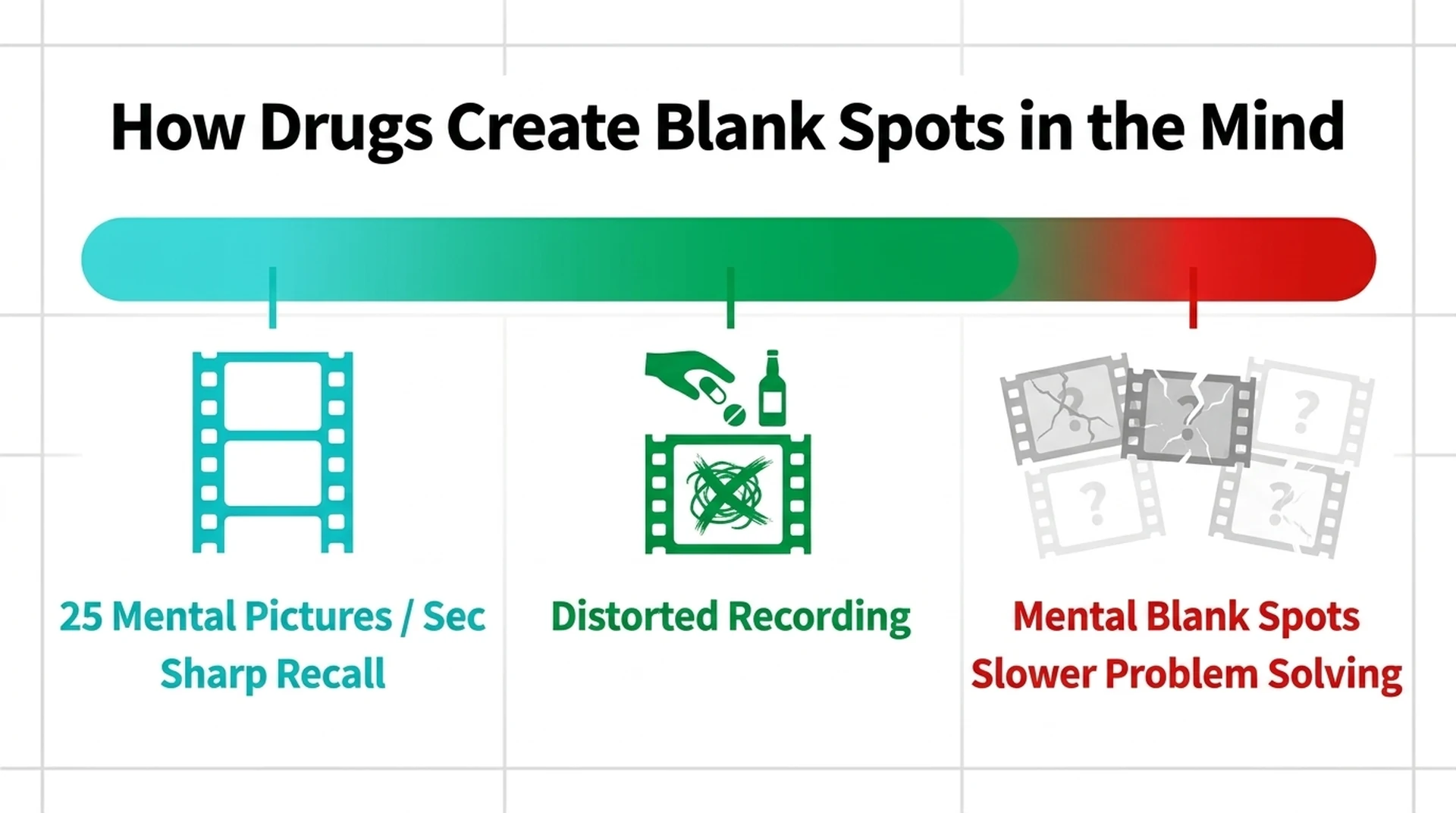
At its core, your mind operates through continuous mental pictures. Every single second, you record roughly 25 mental images—rapid-fire, in exact order, and precisely timed.
Think of very early silent movies, like classic Charlie Chaplin or Keystone Cops films, where everyone appears to move in fast, jerky jumps across the screen. Early projectors only ran 11 to 15 frames per second through the light beam. Because your mind naturally tracks reality at around 25 pictures per second, anything slower looks choppy and unnatural.
Modern cinema projectors run right around 24 to 25 frames per second. That is why a modern film looks smooth and lifelike: the projector finally matches the natural speed of your mind.
- Continuous recording: Sight, sound, physical sensations, and context are stored in sequence.
- Instant retrieval: When you face a situation in the present, your mind scans past recordings in a fraction of a second to supply the answer.
- Everyday problem-solving: Driving, studying, reading social cues, and reacting quickly all depend on clean, sequential mental recordings.
What Narconon Calls “Blank Spots” in the Mind
What happens to that 25-frame-per-second recording system when someone drinks heavily or takes a drug? During intoxication, the mental pictures recorded by the mind become distorted, foggy, and blurry.
Almost everyone has heard someone say after a Saturday night party: “I must have had a great time last night, because I barely remember getting home.” At Narconon, those missing or blurred intervals are called blank spots in the mind.
- Blurred sequences: Instead of crisp, ordered impressions, the mind stores hazy or incomplete fragments.
- Cumulative buildup: Each episode of substance use adds more blank spots to a person’s mental timeline.
- Slower recall: When the person tries to retrieve information or make fast decisions later, the mind has to work around missing data.
Why Mental Sharpness Slows Down Over Time
A single blurry evening might seem harmless at first. The real issue appears as those blank spots accumulate over months or years. Instead of acting like a fast, reliable computer that delivers immediate answers in present time, recall begins to lag.
Recognizing this mechanism helps young people and families understand why concentration, study habits, and everyday problem-solving gradually feel harder under regular substance use—even long after a weekend night is over.
Weitere Ressourcen
- 🎬 Watch all animated episodes: Narconon-Videothek.
- 📘 Read our alcohol facts guide: Alcohol: What You Need to Know.
- 🌍 Learn more about drug rehabilitation and prevention at Narconon Europa.
10 Things Your Friends May Not Know About Drugs: Complete Series
- Part 1: What is a Drug?
- Part 2: What Are the Effects of Drugs on the Mind? (Current Episode)
- Part 3: Why Do People Take Drugs?
- Part 4: What Is Addiction? Why Most Drugs Are Habit-Forming
- Part 5: Is Alcohol a Drug? How Alcohol Works on the Body
- Part 6: Is Marijuana Harmful? The Hidden Magnesium Trap
- Part 7: Is Ecstasy Safer Than Other Drugs? The Truth About MDMA
- Part 8: Do Drugs Increase Creativity? Emotions vs. Artificial Highs
- Part 9: Do Drugs Improve Your Senses? How the Nervous System Reacts
- Part 10: How Long Do Drugs Stay in the Body? Fat-Soluble Residues Explained
FAQ
Q1: Do most drugs affect the mind even in moderate amounts?
Yes. Any intoxicating substance alters how clearly the mind records experiences while under its influence, creating blurred or foggy impressions.
Q2: How fast does the human mind record mental pictures?
The mind records approximately 25 mental pictures per second in continuous sequence, similar to the frame rate of modern motion pictures.
Q3: What are mental blank spots?
Blank spots are periods recorded while intoxicated where mental images are foggy, distorted, or missing—such as forgetting parts of an evening after heavy drinking.
Q4: Why do blank spots make everyday problem-solving harder?
Because you solve present-day problems by rapidly scanning past experience; accumulated foggy recordings slow down memory retrieval and reaction speed.
Q5: Where can I watch the rest of the 10-part myth-busting series?
You can watch every episode in the Narconon Video Library or follow the 10-part series links right on this page.